



Stories about the past and present of the marsh near where I live, Cootes Paradise Marsh.
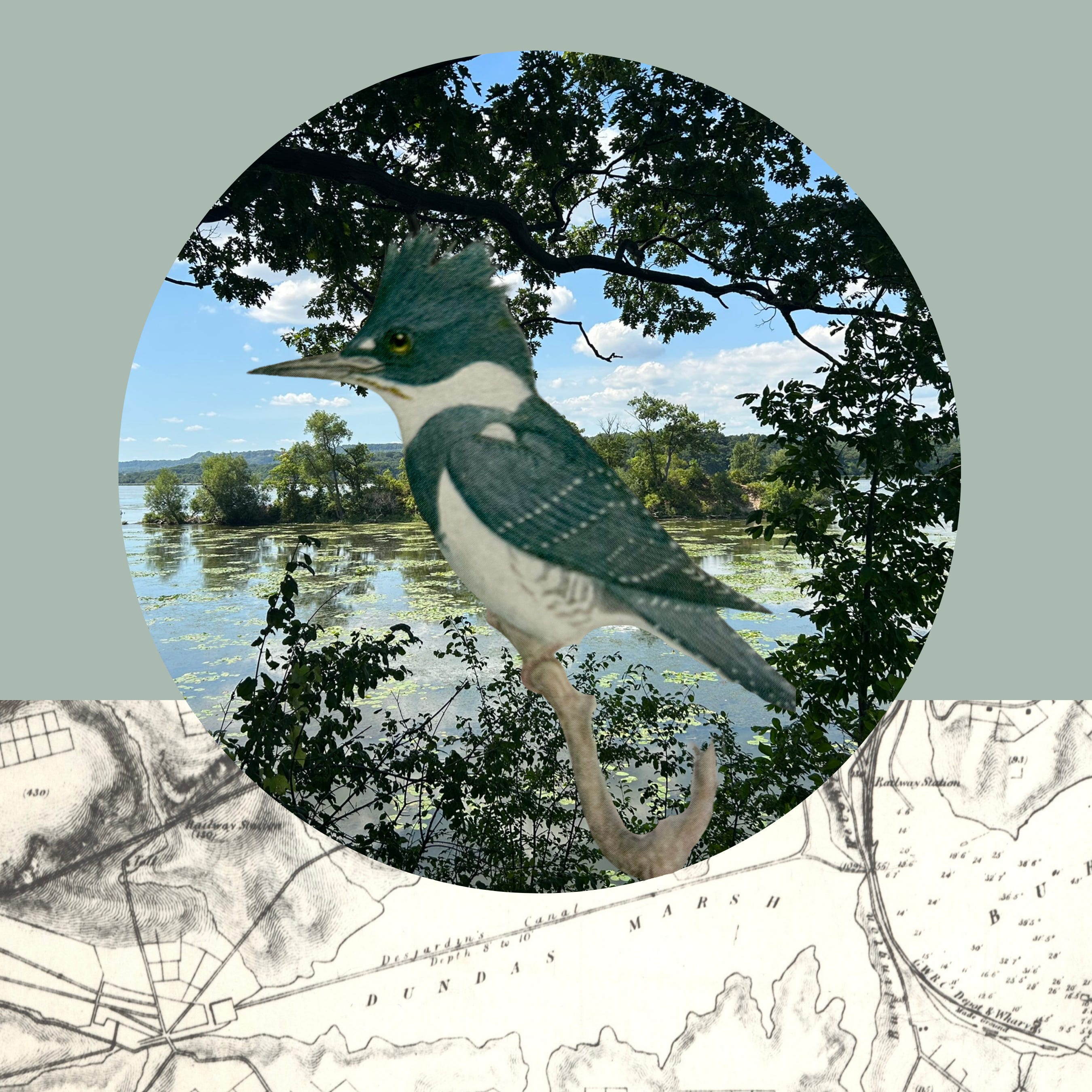
Belted Kingfisher
The Belted Kingfisher (megaceryle alcyon) is a bird I can easily identify, because nothing else around here looks like it. It is the size of a robin with a giant head, almost like a distorted bluejay. Percy Algernon Taverner, from Guelph, wrote in 1922: “The great ragged crest and slaty blue back of the Kingfisher cannot be very well confused with any other American bird.”
I notice it when I paddle Cootes, flying over the water and into tall trees, sometimes appearing to follow my canoe’s progress. I think when I see them I’m only seeing one. I hope I’ve developed a heightened sense of awareness after spending hundreds of hours on the marsh, but it’s hard to be sure I’m seeing the same Kingfisher while I’m paddling. I have not been able to differentiate males and females. In pictures, illustrations or photographs, it’s clear. Unusually, the female Kingfisher has more colour than male; the males have one blue band across a white breast, while females have a blue and what is described as a chestnut, or rusty, band.
Percy described their behaviour: “All frequenters of Canadian waters know the Kingfisher. It sits motionless on a commanding perch over the water watching for the fish below. Suddenly it dashes off, hangs suspended a moment in the air, and then drops with a resounding splash into the water, rising a moment later with a luckless fish in its capacious bill, and is off around the bend of the stream. Within its daily range the Kingfisher knows every perch and branch from which it can get a comprehensive view of its fishing grounds and returns to them again and again.” What happens next was described by Hamiltonian Thomas McIlwraith in his book The Birds of Ontario: “If a fish be secured, it is carried in the bill to some convenient perch, on which it is hammered till dead, and then swallowed head downwards.”
Neither Thomas, writing in 1894 or Percy in 1922 describe the Kingfisher’s sound. Roger Tory Peterson doesn’t either in 1949’s How to Know the Birds. But the simply named Bird Guide, finding its way to my hands from my great great aunt’s library, published in 1909 does: “a very loud, harsh rattle.” I still find myself unable to isolate or remember the sounds of birds in nature, so based on the sound that I hear on the Cornell Lab of Ornithology’s website, I think it sounds like a squeegee. Cornell describes it as a piercing rattle.
According to Birds of Hamilton and Surrounding Areas, most Kingfishers migrate, some surprisingly far south, but sometimes one or two stay for the winter when there is open water. But they won’t stay if there is a complete freezeup. By the Hamilton Christmas Bird Count, when birders across North America of all skill levels count birds on Christmas day to record population data for conservation, there are usually a few Kingfishers still around. Christmas day Kingfishers peak at 13, the max number counted since 1971, matched in 2018, when an exceptional thirteen historical high species count records were either set or tied. According to the 2018 report: “No doubt the lack of ice in the waterways so far this winter has allowed more of these birds to fish in the local streams and waterways with ease.”
They are hardy birds. Thomas wrote: “They are not sensitive to cold, for in open seasons I have seen them remaining till January, but when the frost forces the fish to return to deep water, the Kingfisher’s supply of food is cut off, and he has to move to the south.” Prolific birder George North wrote that he found a female Kingfisher frozen to a rock at Desjardins Canal in February 1934 during -25°C weather.
The solitary Kingfisher roams extensively appearing in the Galapagos Islands, Hawaii, the British Isles, the Azores, Iceland, Greenland, and the Netherlands. And then they are back by late March, when they set up territories and excavate tunnels in sand or clay banks for their nests.
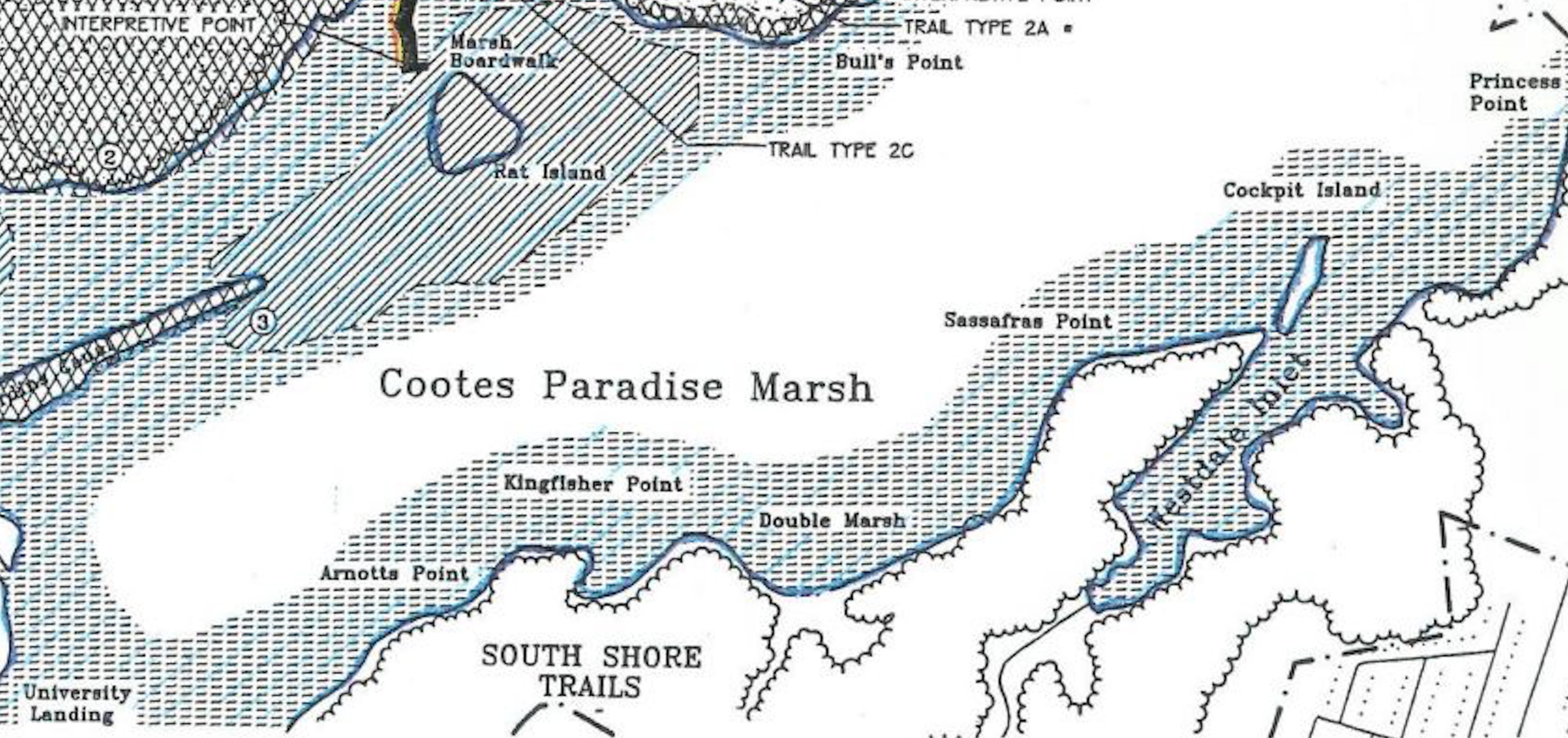
There was a Kingfisher Point on Cootes Paradise Marsh, but it doesn’t appear on maps recently produced by Royal Botanical Gardens, who manage the lands. I found it named on old conservation reports and plans. I imagine someone once saw a Kingfisher nest tunnelled into the banks there. Kingfisher Point is just southwest of Sassafras Point, on the south shores of the marsh. It is the point between Sassafras Point and Arnotts Point, somewhat unhelpful as Arnotts isn’t used on modern Royal Botanical Gardens produced maps either. Ecologists are still using the name to describe remediation activities that are planned or completed.
According to the Cornell Lab of Ornithology, the Belted Kingfisher is a species of low conservation concern. Locally, Birds of Hamilton and Surrounding Areas reported in 2006 that “the Kingfisher has changed little in status since Thomas McIlwraith reported it as common along the shores of Hamilton Bay.”
Belted Kingfishers are back on Cootes after a long, snowy winter. iNaturalist, a citizen science social network where users share biodiversity information, lists observations as late as mid November, with two sightings mid January and late February, before regular sightings late March and early April. I haven’t seen one yet but then again I almost always see them from my canoe, and we’re still a few weeks away from paddling season.

I will be looking for a belted kingfisher on Lake Simcoe this summer. Thanks.
Hi Grace - a lovely style of writing weaving together history, personal experience and birds!