By mid-July I’d already gone family camping twice: one backcountry and one car camping trip. I immediately felt immersed in summer and nature, like diving off the dock into an Ontario lake, the shock of fresh water, the novelty, the happy disruption.
One of the best parts of our camping trips was the less-familiar nature 300 kilometres north of home. Being in a new landscape felt a bit electrifying to me; I was surprised at how hungry I was for it. M- and I both noticed bits of nature that built on our skills and knowledge acquired during native plant gardening at home, and hiking around the northeast section of Cootes. That 2.75 km hike has become a routine; it has allowed for depth of knowledge and a sense of connection to the land for both of us. But it was gratifying to watch four-year-old M-’s connection to nature in a new landscape. I noticed how nature supported M-’s intensity, his interest in information and facts, and his instinct to share with others.
Our backcountry trip was on Georgian Bay, where we camped on Moon Island. Soon after we landed our canoes on our site I found a large feather from some bird of prey and handed it to M-. He told everyone it was an eagle feather and proudly brandished it too much for my husband’s comfort. I looked it up, admittedly not until we got home, and bird feathers aren’t the disease carriers they have been rumoured to be.
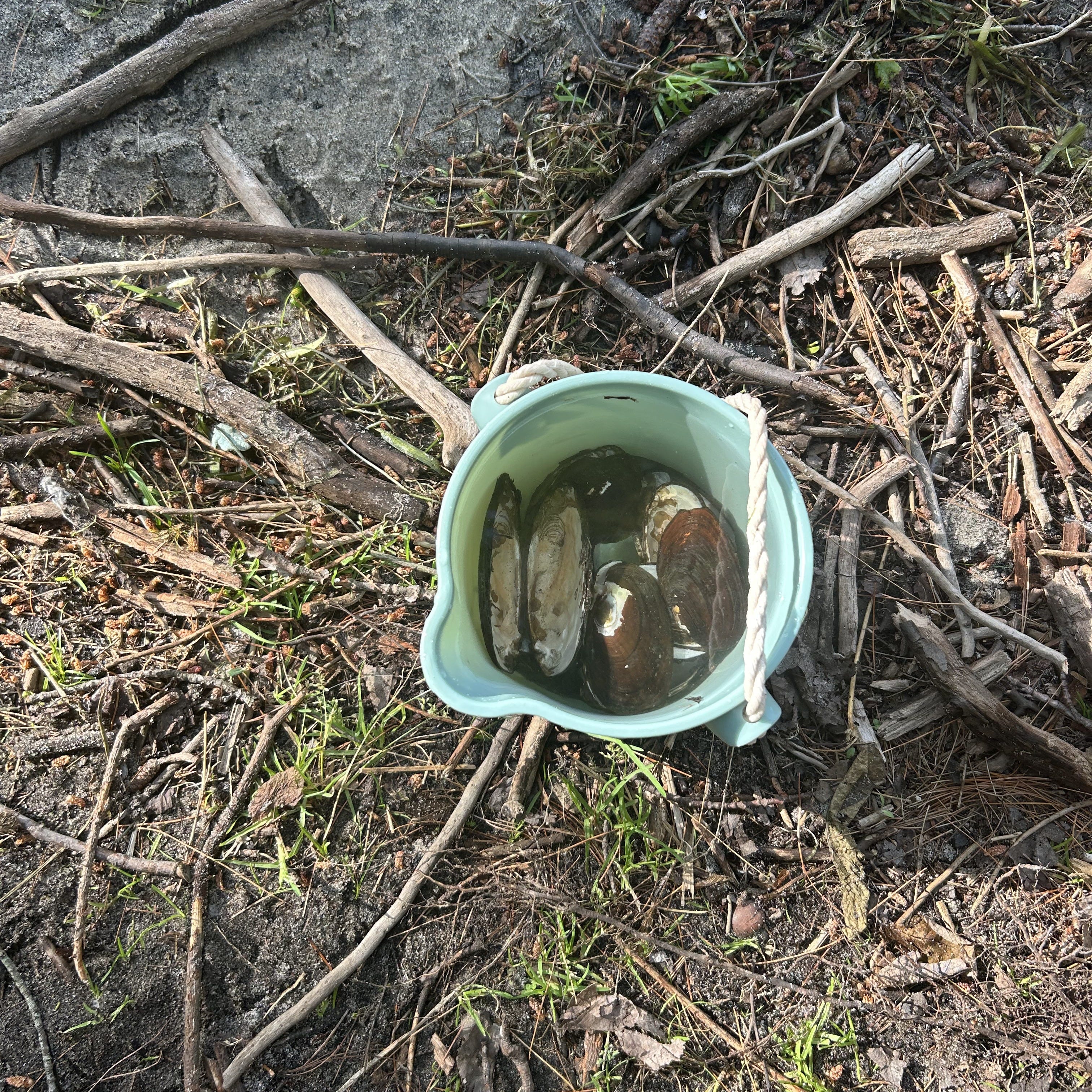
Mussel collection
Our site had a shallow beach and M-. and the other kids, both 3-4 year olds, spent a lot of time playing in the water. M- became instantly obsessed with gathering empty mussel shells, immediately calling it his collection and showing every child and adult. The other kids played and splashed and moved on from activity to activity while M-’s obsession deepened and he got louder and more passionate about his collection, making deals with various adults while they were on lifeguard duty to help him collect more shells, until his pail was overflowing.
Ferns
We went on a 5 km hike that turned out to be too long for 3-4 year-olds, up and down hills knotted with roots and rocks. I noticed sensitive fern and marginal wood fern. There were a few days last summer when I hiked the whole marsh trail system around Cootes where I really looked at the variety of ferns around the marsh and knew their names. Only fragments still remain in my brain. Here I noticed the prehistoric looking Sensitive Fern, and the doilylike Marginal Wood Fern. I was thinking about ferns to myself when I heard M- twenty feet ahead explaining to my husband why he needed to turn around: I need to tell Mumma something, he said. Scott, unwilling to stop the forward momentum, didn’t let him get back to me. M- called out desperately, Mumma, I found a fern!
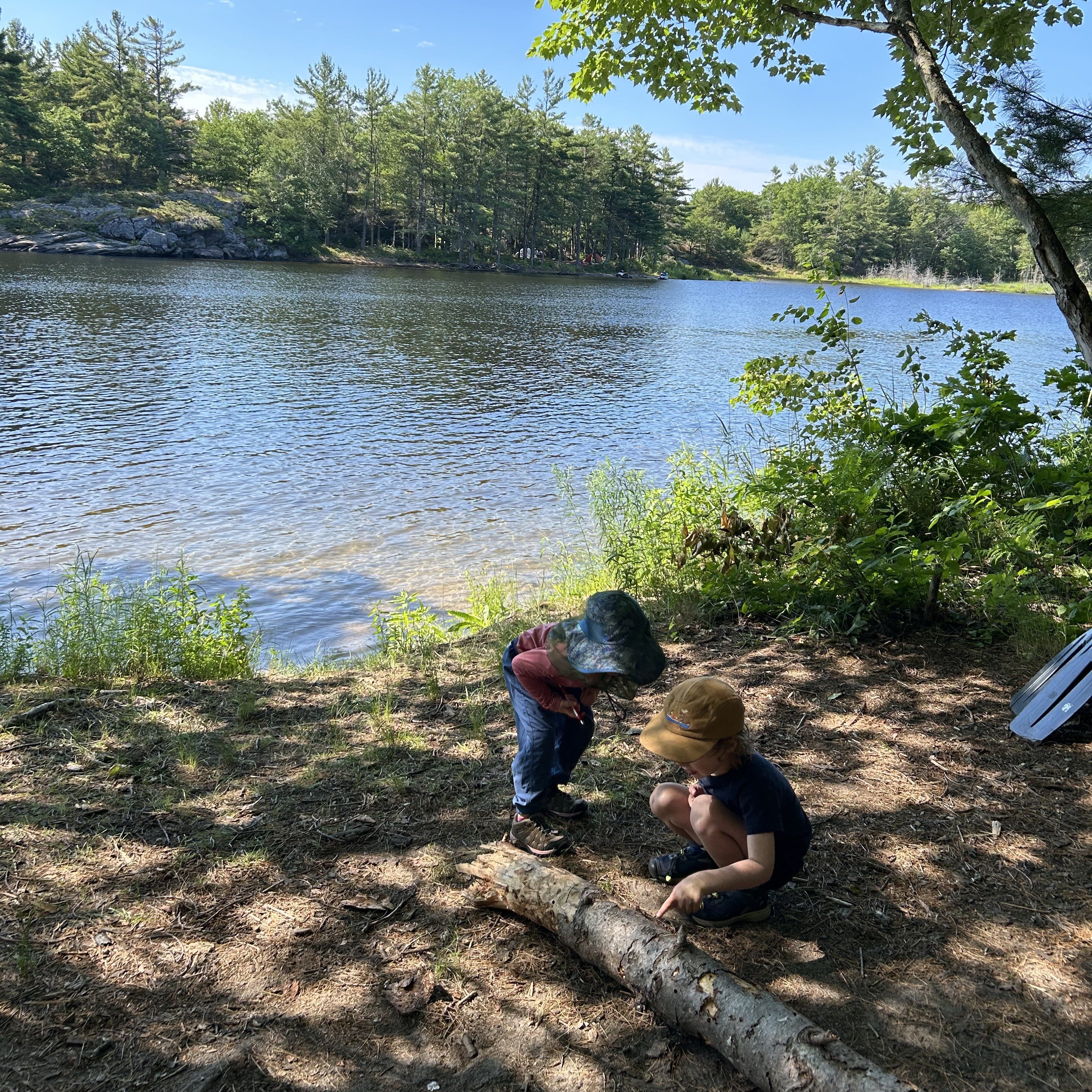
Woodpecker holes in log
On our last morning, as the adults packed up the tents and kitchen items, M- pointed out a hole in a log near the campfire pit: Mum, I see a woodpecker hole.
Oh yeah, I said, looks like there are a few of them. He crouched with Z-, and after he had shared with her, he tried to show N-: N-, he said, a woodpecker has a sharp beak and they make little tiny holes, like one there, and one there and one there and one there. I watched as N- didn’t respond, and M- deflated a little, wanting to share what he knew. I tried to let it happen, to let him learn that not everyone is interested in the same things, to let there be space so he could learn to move on, but I failed to do this, and we talked more about the woodpecker holes together.
One week later we were another 100 kilometres north, car camping with both kids and our neighbours from Hamilton and their almost 4 year-old. Camping with a 4.5 year-old and a 15 month-old was a lot of work, despite the support from our neighbours, but also completely magical.
After a long drive, slowed by highway traffic and bathroom stops, I vowed we’d never aim this far north to camp with young kids again, the added hours couldn’t possibly be worth it. But upon arrival, I found the landscape thrilling, massive rock covered in mosses and lichens in hundreds of shades of green, wild blueberries, and stately white pines.
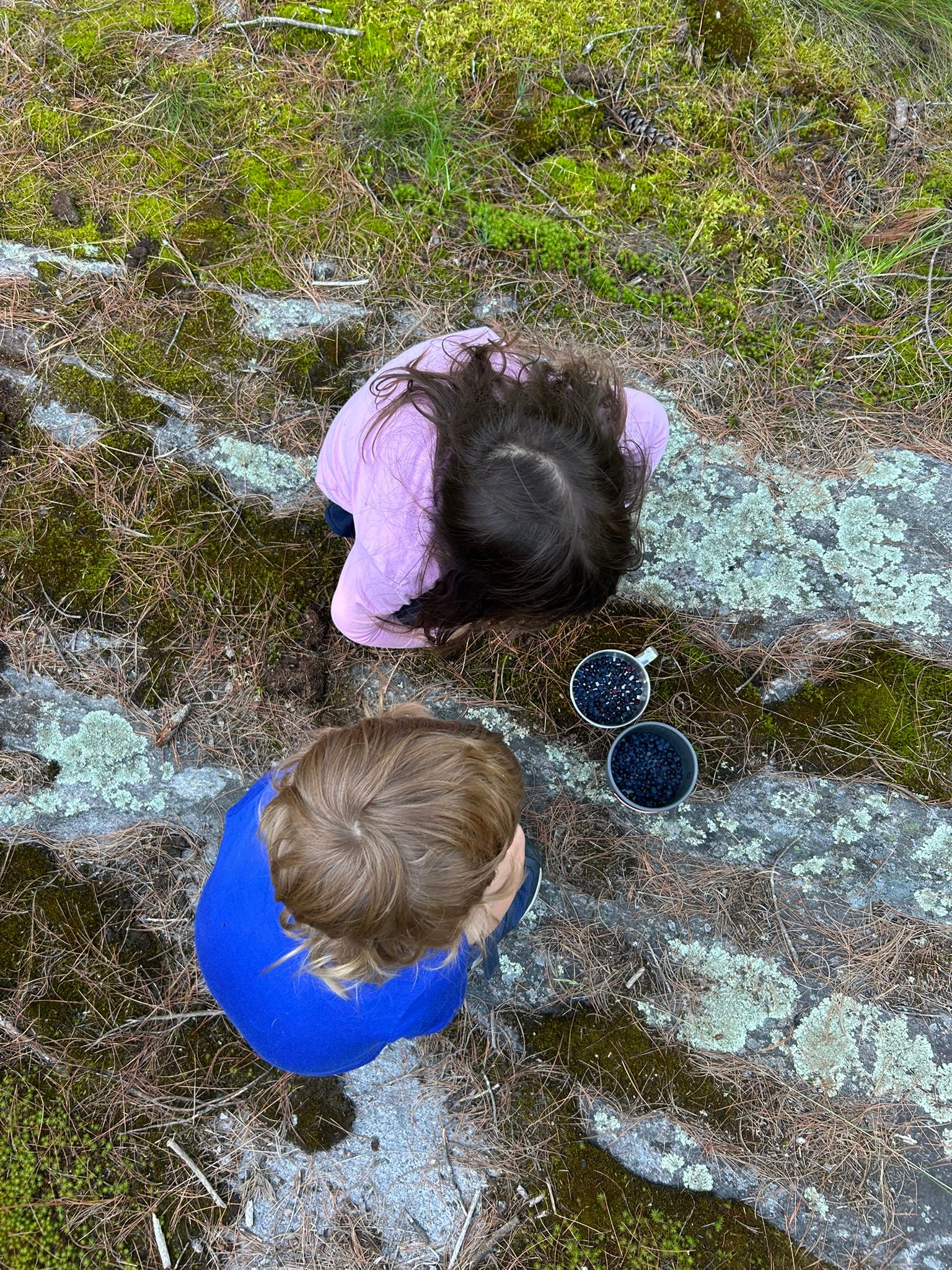
Wild Blueberries
While the adults set up tents and got dinner started, I took all three kids, M-, P- (almost four) and I- (15 months) over to an area where I’d noticed blueberry plants, and they quickly became adept at picking the purple-blue berries. While M- is reasonably generous for a 4 year old, he refused to share his berries. We went on another completely beautiful but too-long hike, just him and I, and the further we got, the more plentiful the blueberries. The plants got thicker and the berries themselves got bigger and bluer and sweeter. M- only stopped to pick berries about every ten feet or so, in between examining moss and snails and moose scat.
Feet in marsh
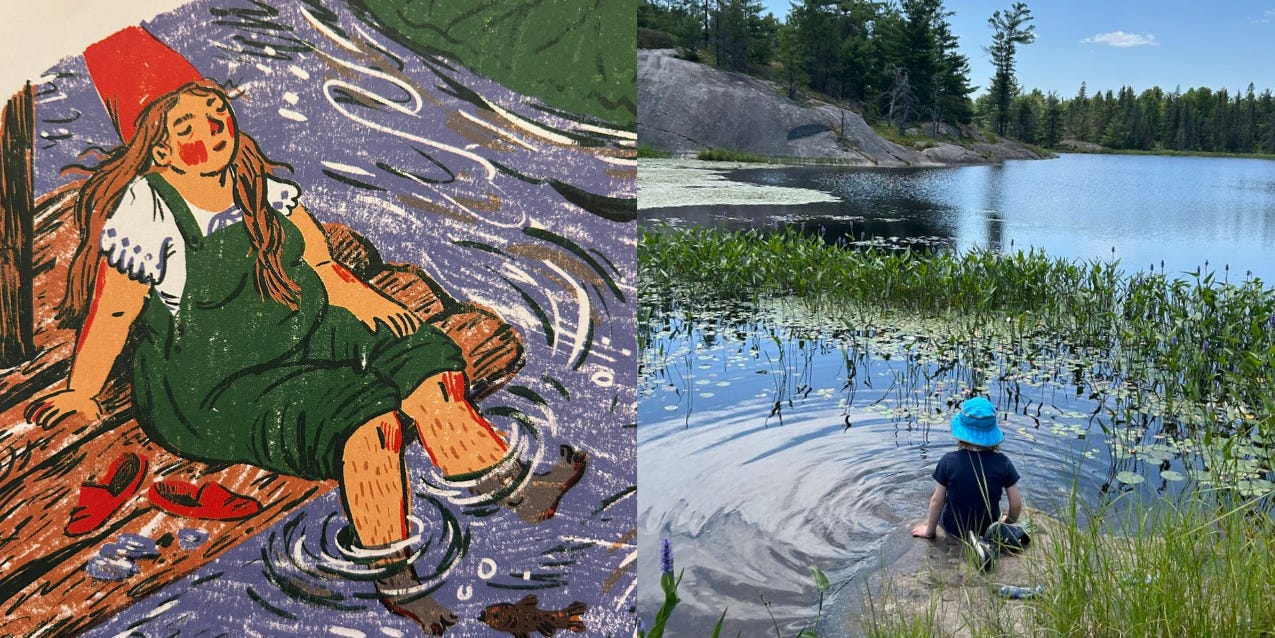
We’d been on the hike for all of ten minutes when, while crossing a wetland boardwalk, M- saw a large flat rock sticking out into the marshy area. He quickly took off his shoes and socks and said he wanted to cool down and dip his feet in the water. I suspected he was thinking of one of his favourite books, where in one story Witch Hazel is fixated on getting stuff done on a hot day, and is persuaded by her friends to relax and enjoy the sun and conviviality. Her body starts to relax once she dips her feet in the water. I was charmed by M-’s idea and intention and allowed this departure from the boardwalk, only for him to fall in the water two minutes later. I grabbed him and pulled him out, his clothes soaked. He had a tiny cut on his foot, and the blood made him cry. I had a spare shirt and a first aid kit, and once he was half dry, in a dry shirt but wet shorts, bandaged but sockless in his shoes, we ate a snack. He recovered surprisingly well, and now talks about it as a fond memory.
Spittlebug
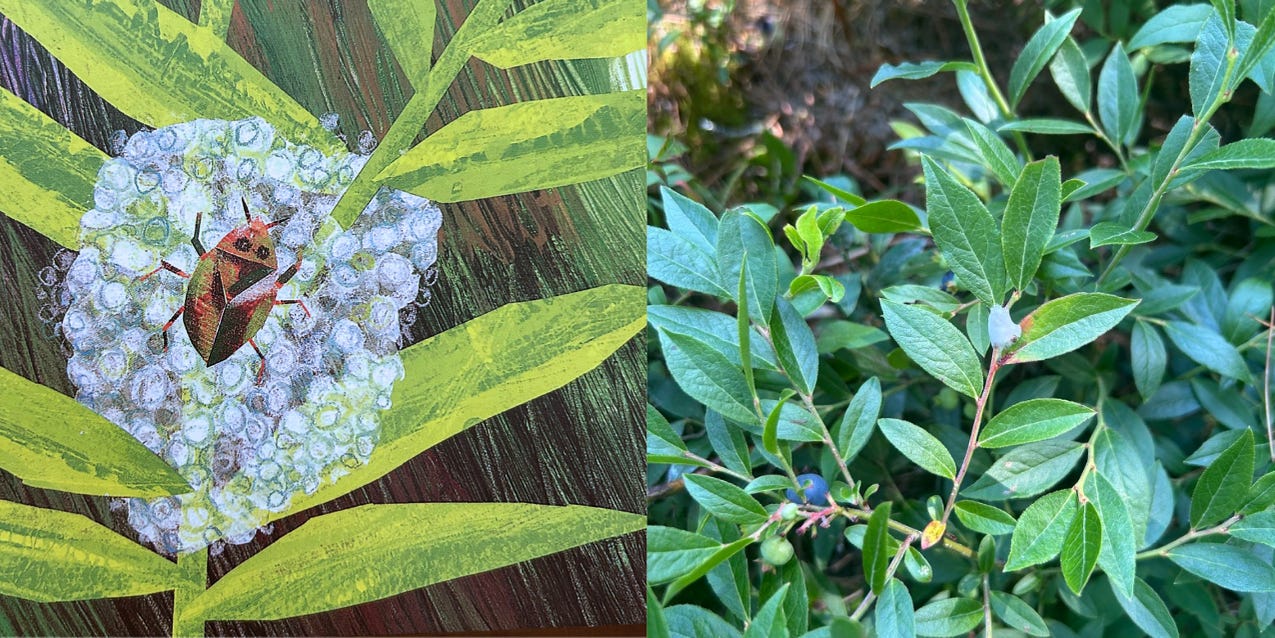
On the hike, during yet another blueberry feasting session, M- pointed out a foamy stem on the blueberry plant. Look at the bug’s froth, he said. I didn’t know what he meant but was impressed by his word choice of froth. Then remembered the Eric Carle book we had checked out from the library. It was a spittlebug, maybe the Dogwood Spittlebug (CIastoptera proteus) which feeds on dogwoods and blueberries. We didn’t actually see the insect because it was cloaked in foam.
White water lily
On a paddle around Clear Lake M- pointed out White Water Lily from the canoe. I had toddler I- standing between my legs in the bow, somehow instinctively trying to wrest the control of the paddle from me and dip it into the water. It was magical! Meanwhile M- used his canoe paddle like a pizza peel and collected some aquatic plants including a water lilypad. He was excited to show me that the underside of the lilypad was pink-red, and he solemnly turned it over to show me again and again, like a flip book. I’ll put it back into the ocean, he told me, the error another reflection of his active reading life. Earlier he had told us, I have to go swim in the sea. We haven’t corrected him.
Bush honeysuckle
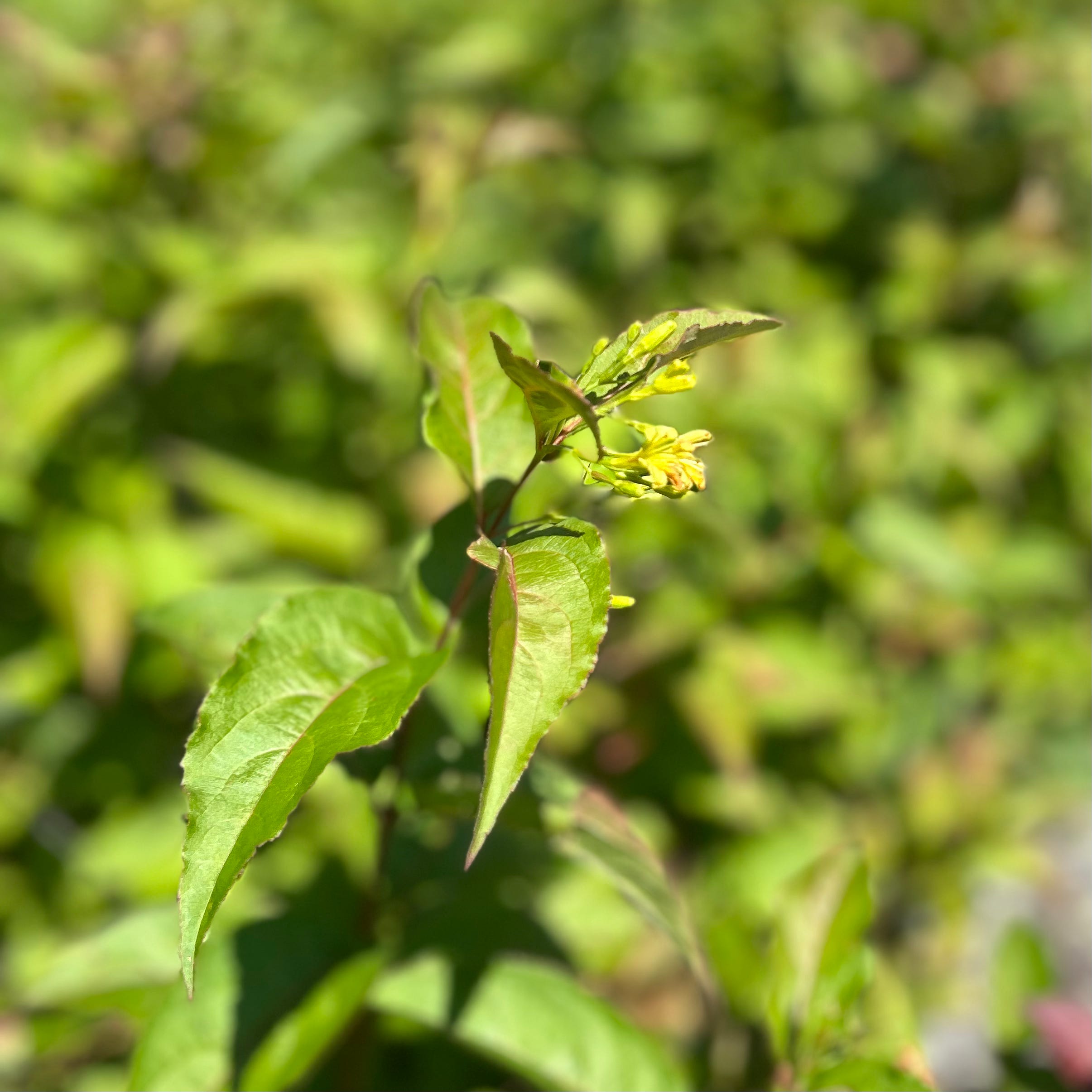
Perched on the top of the rock barrens on our hike, sprawling in the hot sun, their leaves green and red, I saw the same yellow blooms that I saw in my garden: bush honeysuckle. Recognizable both for the leaves and a few yellow blooms, I was very excited to see this out in the wild for the first time.
White pines
It was 2023 when I learned how to identify white pine, and since then I’ve been observing them throughout the seasons. In the evening, though M- longed to get into the tent I’d learned my lesson on my fourth night camping this year, and aimed to keep him outside the tent until he was exhausted. (Despite my efforts he became energized the second we zipped ourselves inside our tent, and he woke up I- within seconds). We walked the campground, looking at different campsite set ups as the light changed, and M- admired campfires and twinkling lights. We sat at an empty campsite, and he ate goldfish crackers and dried cranberries while I watched the white pines. Between us and downhill to the water it was almost entirely majestic white pines, their ship-mast trunks standing tall and straight. I noticed that they all had long cones hanging from their crowns. I later read that female cones develop on upper branches, while male cones grow on the lower branches, to help ensure cross-pollination between trees and enhance the genetic diversity of offspring.
I appreciated sharing this nature with M-, but the best part of camping was seeing his comfort and confidence, the way he is becoming more himself. I watched him walk over to Allison and N- at the edge of the water and pull off his socks and shoes to sit with them, show Z- a lichen crusted tree, ask Z-’s dad to help him acquire more mussel shells, pick blueberries side by side with P-, carefully roast a marshmallow with his uncle, paddle the canoe, yodel his impression of a loon call, and reluctantly share one single blueberry with his sibling. I wondered if the same is true of myself, if I’m getting more comfortable and confident, because of this connection to nature. Sometimes it feels like two steps forward, one step back because of the constant change parenting requires. I must become a new self every six weeks as my children grow and change, test limits, experience separation anxiety, learn to name their emotions, repeat things they’ve heard me say. Am I becoming more myself, as M- watches me learn about ferns, wonder about the reproductive cycles of pine trees, plant honeysuckle, figure out when to give him space, debate with his dad about the germs on a feather, share my blueberries with I-? I guess the catalyst could be anything, and over my life I’ve probably become more myself because of reading, a part-time kitchen job, solo travel, or grief among other experiences. This is a cool moment to share with M-, when at 4 and almost 40 we are both becoming more ourselves and the catalyst is nature.