



Stories about the past and present of the marsh near where I live, Cootes Paradise Marsh.
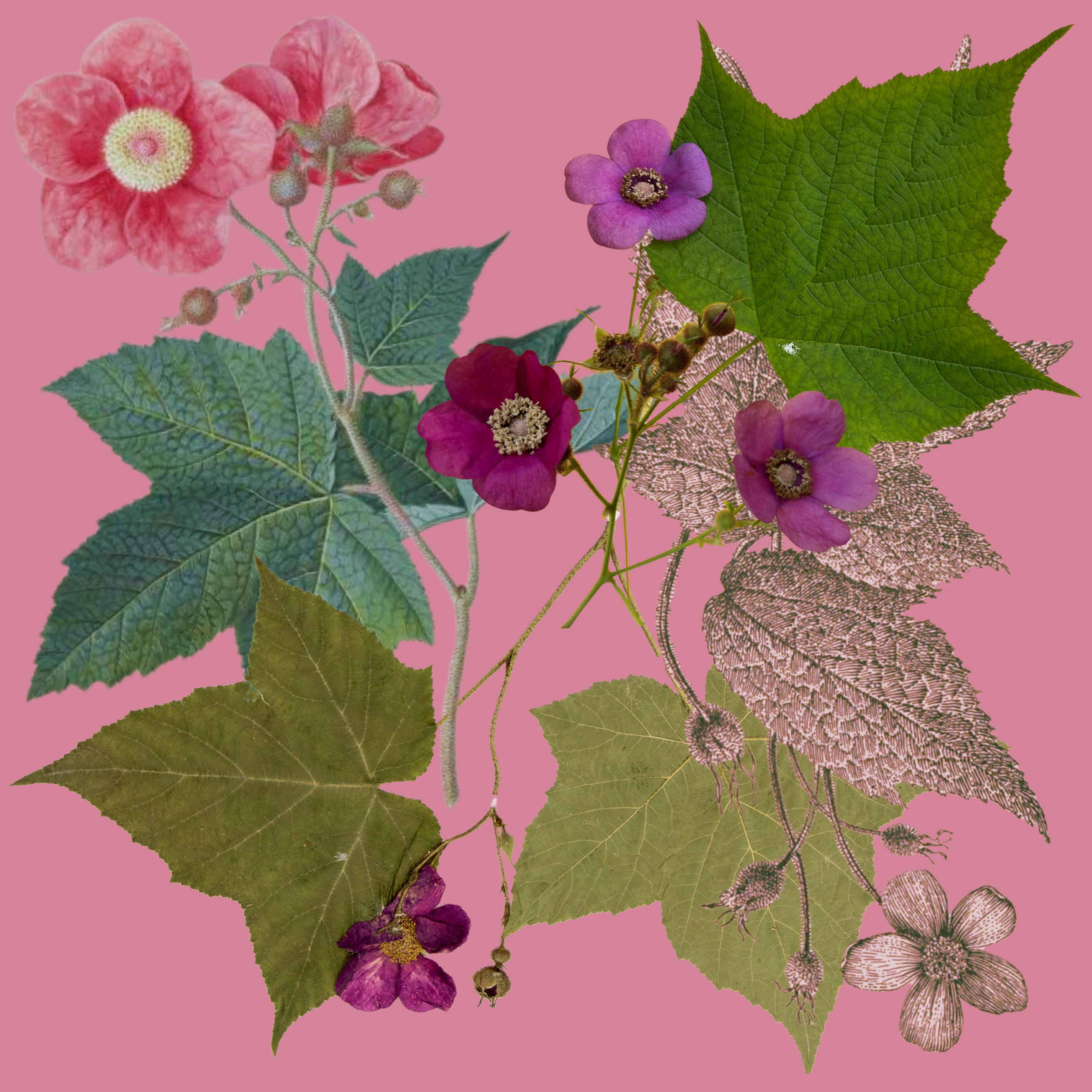
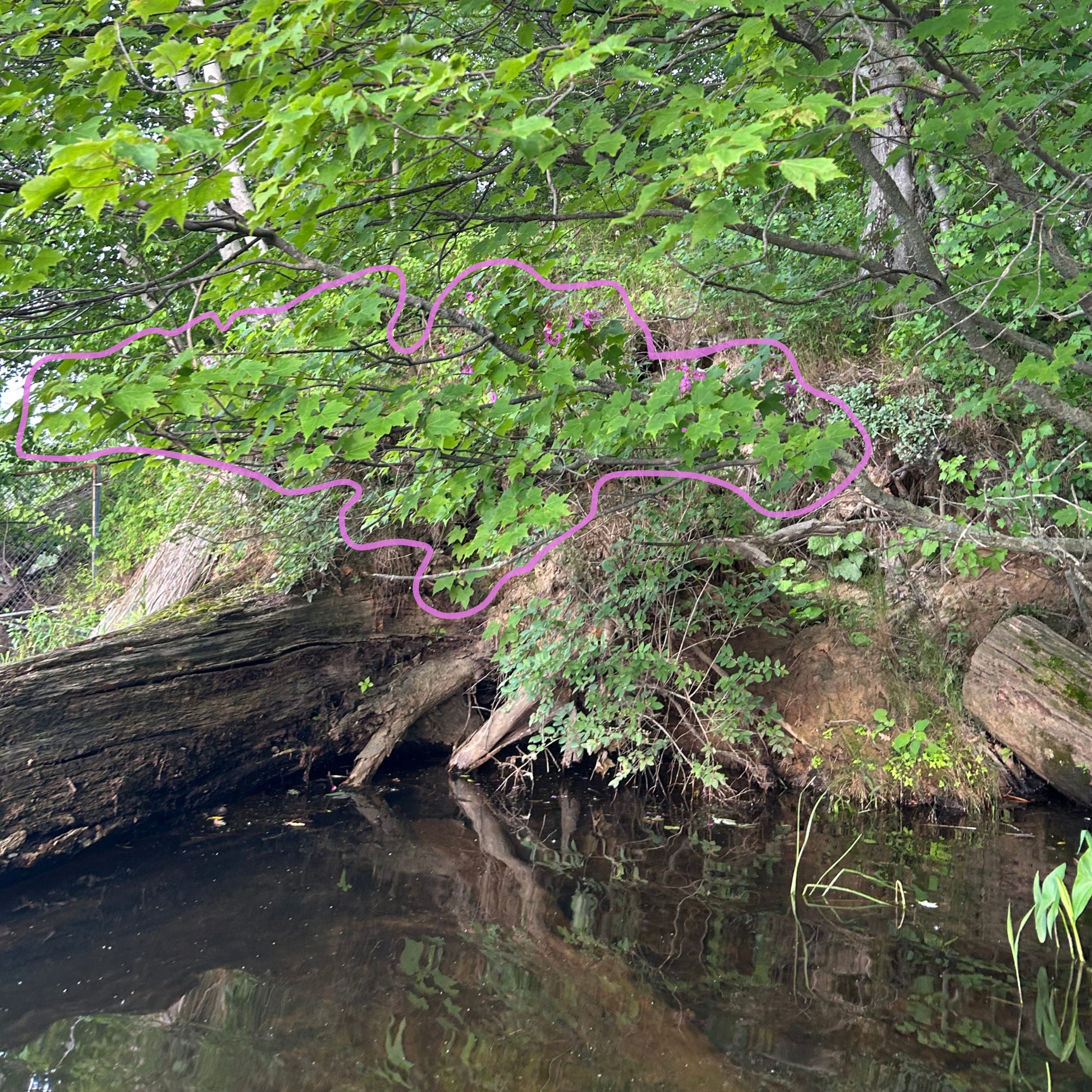
I first spotted purple-flowering raspberry from my canoe on Cootes Paradise Marsh three years ago. The big billowing pile of light green leaves flecked with dark pink flowers perched on a steep bank of the north side of Sassafras Point.
The next summer I planted a seedling in my garden. It didn’t do much last year but this year it is monstrous, has many blooms, but no berries yet.
Flowering purple raspberry is a native plant to Ontario, found east to Nova Scotia, as well as in the eastern United States. This year I have been spotting it around the marsh, both from northshore trails and from the water, including the same spot on Sassafras Point.
Purple-flowering raspberry has large light green leaves resembling maple leaves. It is covered in long-lasting rose-like pink flowers that attract pollinators. The fruit are edible, sometimes sweet and juicy and sometimes dry and mealy, but birds eat them either way. Some refer to it as thimbleberry, a name more commonly associated with the tastier Rubus parviflorus. The plant does not have thorns, but the stems and flower buds are covered in a fine fuzz.
Purple-flowering raspberry appeared only five times throughout the history of the Hamilton Spectator.
An article in early summer 1933 announced new labels at the new Royal Botanical Garden for plant specimens, that would include the scientific name, common name, and distribution of trees and shrubs. Flowering raspberry is singled out as being in bloom: “Visitors to the ravine drive this week will admire the banks of purple flowering raspberry - Rubus odoratus - which are now bright with flower.” The text included an appeal to parents: “Parents of children who frequent the ravines during this holiday season are particularly urged to encourage the children to read, and not destroy, the signs.” Personally, I don’t know what would be safer from the hands of kids, the labels or the plants themselves. The only person in my life who matches my new-found interest in native plants is my four-year-old, M., whose enthusiasm sometimes takes the form of annihilation. I remember doing the same thing as a kid, breaking apart a blossom, or tearing a leaf along its veins. It’s part of learning, but I find it difficult to communicate the nuance, why we don’t pick wildflowers or from neighbour’s gardens but dandelions are okay to pull apart.
A Spectator column in 1947 called “Flashlights on Nature” heralds the plant: “Little attention is given to the purple-flowering raspberry in its native habitat, the Canadian woodlands. Yet in many English gardens it is admired as a desirable exotic plant. Lovely as a wild rose and about the same size, the blossom of the purple-flowering raspberry (Rubus odorata) appears from June to September, and varies from a deep pink to a purplish-red.”
In 1997 a retired steel worker was profiled for his work cutting back vegetation along Stoney Creek, regularly mowing an entire kilometre of grass. This triggered a debate in the editorial section as to whether he was harming or helping the biodiversity of the area, with one letter defending his activities, listing the trees and shrubs that remained intact and flourishing along the river, including wild flowering raspberry, cow vetch, mallow, milkweed, wild rose, lily, and giant cow parsnip.
In 2003 a student at Orchard Park Secondary received a grant to improve the school’s courtyard with five different native plants, of which flowering raspberry and flowering dogwood were highlighted.
And most recently, a residential garden in Dundas was profiled in 2024 for the owner’s work transforming her garden to support biodiversity and pollinators. The garden was home to more than 400 different plants, most of them labeled. Out of 10 types of trees, 19 varieties of shrubs, two vines, 12 grasses and sedges, seven types of ferns, 25 species of spring wildflowers, 44 summer wildflowers and nine fall wildflowers, it was the purple-flowering raspberry that got a close up, a photograph of a blossom with water beading on its petals.
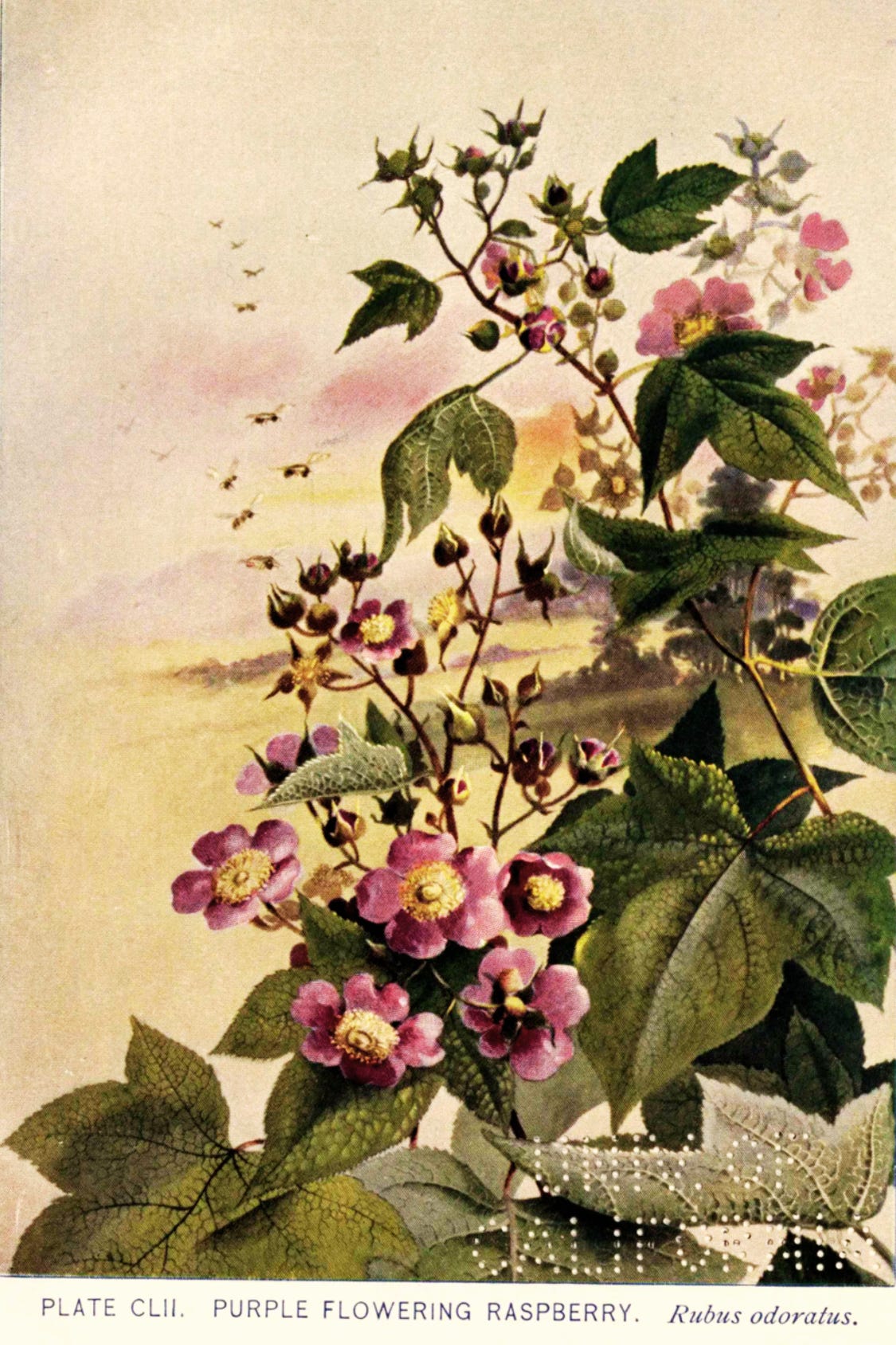
If you’ve never thought about purple-flowering raspberry’s moral character or suitability as a drinking vessel, you might read its entry in A guide to the wild flowers (1899) by Alice Lounsberry: “Hardly any description is needed of the purple-flowering raspberry as it is portrayed so clearly and beautifully by the coloured plate. We can all see that there is nothing plebeian or coarse about the plant. Its moral tone is evidently of the very highest. The leaves grow to a great size, and when folded together make excellent drinking cups, which often enable the weary traveller to quench his thirst by some near-by stream. As we all know, the berries are delightful.” And yet, in other sources the berries are described as mealy, tasteless, edible, nutty, insipid.
Purple-flowering raspberry was carved into the House of Commons as part of what the architect envisioned as a pictorial diary of Canada in stone. A 1938 article from the Globe and Mail describes stone carvers working at the entrance to the Peace Tower. They were cutting Canadian wildflowers into the arch, including trillium, water-lily, iris, purple-flowering raspberry, Jack-in-the-pulpit, and dog’s tooth violet.
But despite this conveyance of importance, it seems like a bit of a deeper cut for a native plant; only five mentions throughout 180 years of the Hamilton Spectator, and I’ve found that it doesn’t always show up in both early and modern Canadian wildflower books. And I haven’t noticed it in any gardens. With plant identification, it takes a while for the geometry of the leaves to imprint themselves on me, for me to start to recognize them while I’m out and about. At first they remain unfamiliar, the way I might stare blankly at someone out of context, like a coworker at the beach. But once I’ve memorized it I start to see it more. But I’m only spotting it in the wild. Maybe it’s because even in a garden of native plants it seems a bit unruly. I doubt my neighbour, who once called my front lawn a jungle, enjoys the swells of it near my front porch steps.
It’s probably not a coincidence that the most common native plants in southern Ontario gardens look like cultivated flowers, plants like Black-eyed Susan and Echinacea. Purple-flowering raspberry plants grow at a much larger scale, with enormous stems and leaves. Hydrangeas, which are not native, get similarly big but their flowers are huge too, and they appear tidier. There is an unwieldy quality about purple-flowering raspberry, the height it gets, the directions the branches stick out at, and the small ratio of flower to greenery. It is the most foresty native plant in my garden. Maybe that’s why I like it. I like how the branches stretch up and out; the plant feels shaggy and spacious and airy. The flowers are nice, but I love the fuzzy flower heads, like miniature pomegranates. Like wild bergamot, planting purple-flowering raspberry was another case of native plant gardening strengthening my plant identification skills in the wild, and making my garden feel like an extension of Hamilton woodland.

I love BES because they are so resilient. I love the purple flowering raspberry plate!