


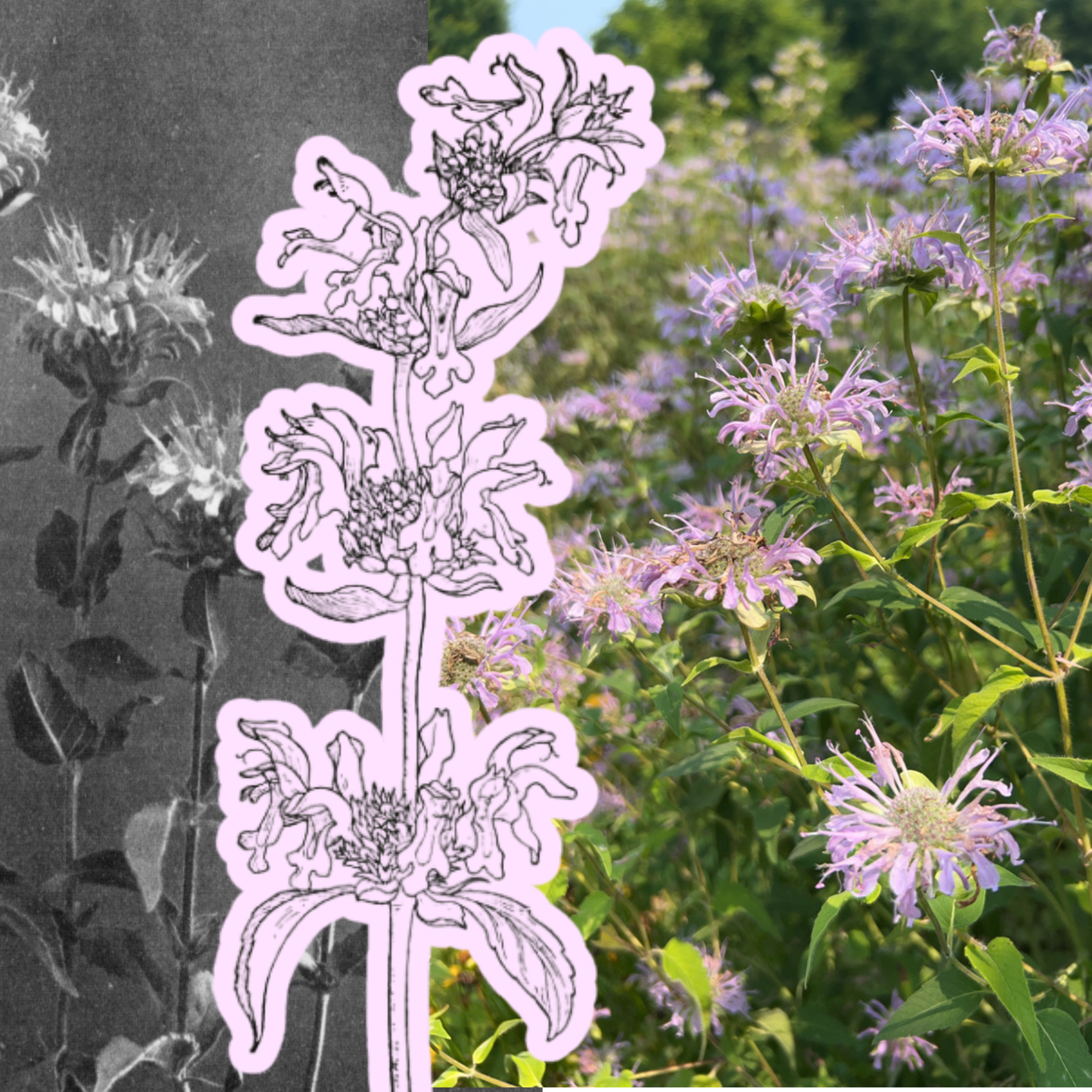
Last year, in early August I saw wild bergamot (monarda fistulosa) on the side of Grey Doe Trail, a trail on the north shore of Cootes Paradise Marsh in Hamilton, Ontario. The flowers looked like light pink-purple spiders in groups of two or three, a foot from the ground. With my baby I. strapped to my chest I took a photograph and identified it with my plant identification app. I was familiar with bergamot, the distinctive orange-scented ingredient in Earl Grey tea, but I didn’t know what that meant as it applied to a wildflower in Canada.
As I trudged along trying to pick out more from the sundrenched brush I realized I knew the name because I had purchased it as a seedling to plant in my native perennial garden. Strange, I thought, why hadn’t I seen it bloom in my backyard? Still, I felt the pleasure of recognition, a plant I knew the name of, that I had already started to get to know.
The next day I visited Westfield Heritage Village and saw enormous mounds of wild bergamot, rising in huge swells up to my eye level. My three-year-old, M., and I watched bees collect pollen on the blooms. It was hilarious to see the flowers in mass amounts after giving so much attention to just several flower heads the previous day, each bloom a precious secret.
I was photographing the wild bergamot while a group of three adults watched a winged creature visit the blooms.
It’s not a bee, they said, it’s a hummingbird.
It’s not a hummingbird, they said, it’s a moth.
It looks like a cross between all three, I thought or maybe said, too small to be a hummingbird, too big to be a bee, too small-winged to be a moth. I watched it with them until M. called me over to a bee.
One day later I hiked with I. again and saw huge groups of wild bergamot flowers on the North Shore Landing Trail, south of the marsh. Three days in a row wild bergamot grew across my path. Had it always been all around me? Funny how awareness seems to prompt a sudden ubiquity.
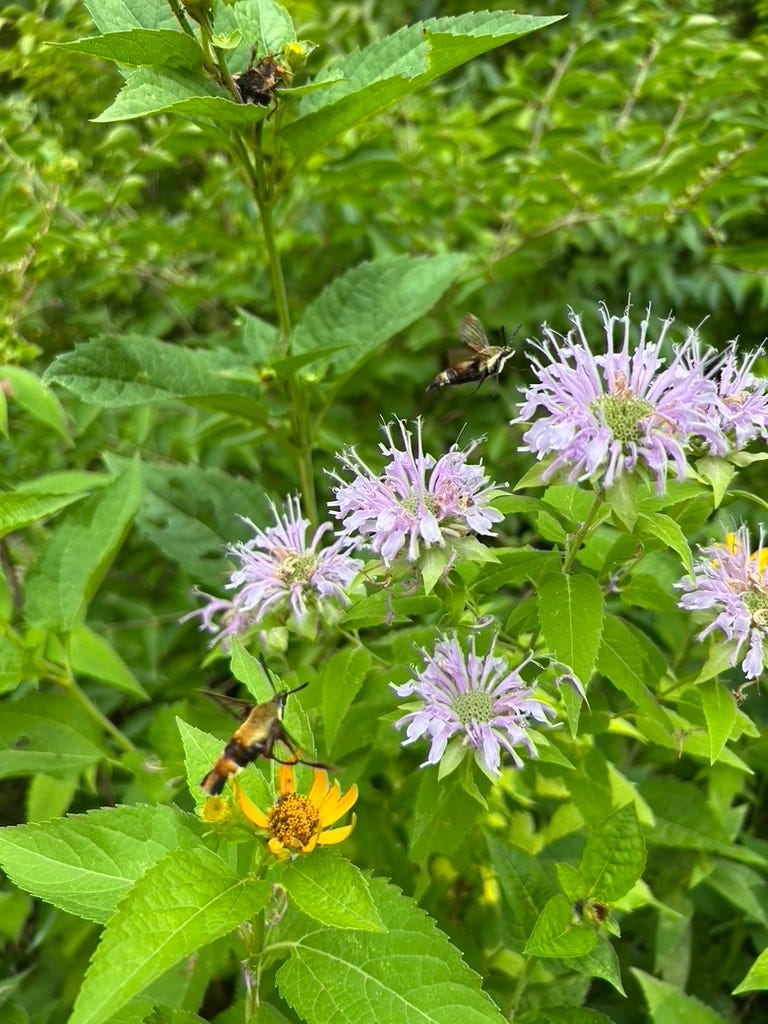
On my third day seeing wild bergamot that winged creature was also there. I took a picture and used the app to identify it; it was a Snowberry Clearwing (hemaris diffinis). It was a moth; sometimes called a hummingbird moth or flying lobster. Its body was thick and arched, with yellow fuzz like a bumblebee, long black antennae and small, transparent wings.
Here on the North Shore Landing Trail tall sections of wild bergamot grew amongst stands of the daisy-like yellow cup plant (silphium perfoliatum) and swaying goldenrod. These thick wildflowers were spread under stands of sumac and hulking black walnut trees decorated with riverbank grape, all green leaved and fresh smelling.
Wild bergamot likes dry and sunny spots. Each flowerhead has 20-30 florets, long tubes that can hold enough nectar for even a hummingbird to pollinate, as well as butterflies and bees who are drawn by the purple, pink, and lilac tints.

The plant is native to North America. In the 17th century, botanist John Tradescant the Younger sent samples of wild bergamot back to England. He found that the crushed leaves of the plant smelled of citrus and mint, similar to that of bergamot oranges from Italy. And so it got its name for the aromatic foliage that protects the plant from herbivores who do not like it. In Alice Lounsberry’s A Guide to the Wild Flowers (Toronto, 1899) she explained that while similar plant Oshwego tea was fragrant down to the roots and strongly scented even after the blooms and leaves have dried up, Wild bergamot’s foliage alone was fragrant. In Catherine Parr Traill’s Studies of Plant Life in Canada (Toronto, 1906) she wrote that all species were “sweet-scented and might be utilized to advantage as an aromatic flavoring, the Bergamot being far more delicate and agreeable than the Wintergreen which is so largely used in confections.”
Locally, a brief, random note in The Hamilton Spectator in 1883 decried herbal remedies, and counts wild bergamot as adding to “the already appalling list of new remedies.”
A 1926 wedding, held in a home just east of Gage Park, unusually featured wild bergamot: “The rooms were beautifully decorated with ferns, wild bergamot and sweet peas.” The bride wore ivory satin with traditional orange blossoms in her hair, but carried a nontraditional shower bouquet of sweet roses and sweet peas. Other than that, wild bergamot was rarely mentioned in the local newspaper until the 2000s, when it started to be recommended as an addition to flower gardens.
In 1939, The Globe and Mail’s Among Ourselves column hosted a discussion about wild bergamot. It was prompted by the column writer, “The Homemaker,” trying to differentiate “red bergamot” and “pale wild bergamot.” The question attracted many responses, readers offering their IDs, their experience with the plant, and references to books. I suppose the column was not much different than an online forum or reddit thread today, the responses collected and presented in print, but the sources of information seem so chatty and anecdotal today. The Homemaker’s friend called and offered the ID of wild bergamot, with a report that “the lakeward slopes at Scarboro’ were adrift with its lovely, misty mauve.” One person wrote in to say that although she hadn’t seen it personally, her friend had gone camping a few weeks ago and had found a wildflower she was told was Oshwego tea, and was going to plant it in her garden. The reader then shared that the very same afternoon she was reading National Geographic, and thought she found the same flower and that it was called wild bergamot. She shared the full description from the magazine, which differentiated the red flowered Oshwego tea (mondarda didyma) from rose-purple flowers of wild bergamot (monarda fistulosa) and horsemint (mondarda punctata). This was given top billing amongst the crowd sourced information. At first this seemed like such a broken-telephone, chain letter-like contribution to me, but it was pretty rigorous when I thought about it.
Someone else sent a pressed specimen of the flower, someone else requested a pressed specimen be mailed to her. Others sent cited descriptions from field guides. One reader offered a common nickname, beebalm, which is also a nickname for the red Oshwego tea. Someone else just wrote to say she had it in her Muskoka garden, but she found wild bergamot to be less hardy than the red variety. We know we have unprecedented access to information nowadays, but it really struck me again reading this.
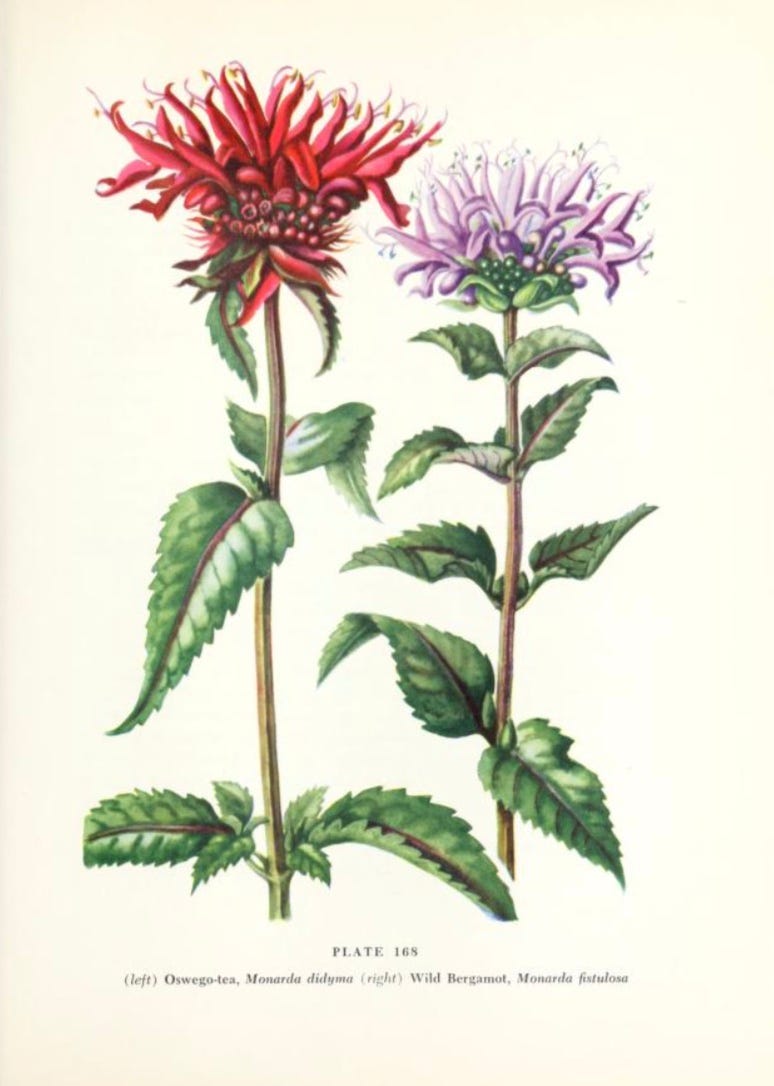
In 1954, The Globe and Mail ran a review of a new book about wildflowers. Illustrated by 410 paintings by Edith Farrington Johnston, the book appeared in my search because the review writer had specifically shared their dislike for the rendering of wild bergamot: “Although I felt that the illustrations were nearly all of high quality, I did not like Plate 168 showing Oshwego-tea and Wild Bergmot.” No explanation given.
With each day that I saw more wild bergamot they seemed to stretch taller and taller, until they were at eye level, which was good because of the 16 pounds I was carrying on my front, I. in the baby carrier.
Looking at the toothed flowers, I now realized, was almost positive, that I had weeded out the wild bergamot I planted in my backyard. Why else would I recognize the name but not the flowers from my backyard? Such was life with small children, my attention was divided, and it was a miracle that I’d even found time to weed the plant I’d specially ordered and planted and watered. Whoops.
Now this spring, the wild bergamot has reappeared in my garden. I’ve given it a wide berth, hopeful that it will bloom this summer.