

"A hard-boiled egg was never safe in the house"
A writerly update for Spring: a research story, a grant acknowledgement

A research story
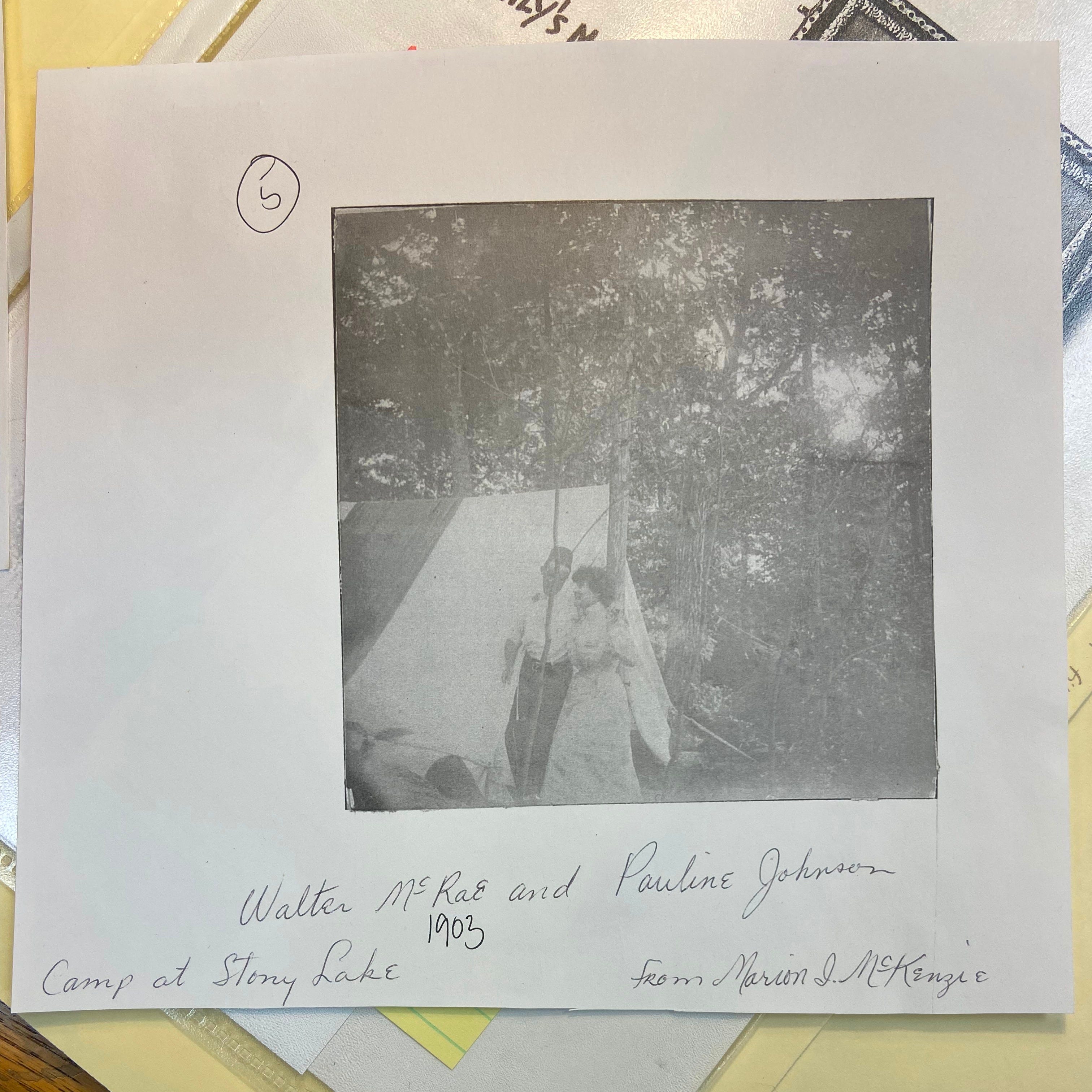
For years now, I have been slowly working on my creative writing thesis, a nonfiction book manuscript, about my experience learning to canoe alongside the canoeing stories of two other women; Esther Keyser (1915-2005) and the Indigenous poet Pauline Johnson (1862-1913).
A few weeks ago, I wanted to find a specific piece of information, a reference to canoeing during Pauline Johnson’s childhood that shows up in Charlotte Gray’s 2002 biography for her. I’ve poured through Charlotte Gray’s fonds at the McMaster University archives before, but I was starting to wonder if I’d missed the particular reference, and since my baby was now in fulltime daycare, I thought I’d visit the archive again and see if I could locate it.
One afternoon in late March I sat in the library basement and sifted through papers. I poured through categories of the fonds I hadn’t looked through before as well as ones I had but wanted to look at again more thoroughly. I found charming anecdotes from Pauline’s friends about canoeing together, fragments of letters that mentioned paddling the Grand River, an 1897 newspaper article noting the difference between the Toronto Bay canoeist’s paddle stroke and the “Indian” stroke used on northern lakes. I did not find a primary source or reference for what I was looking for, but I took pictures of pages of documents, photographs, typed letters, handwritten letters, most of which contained Charlotte’s handwritten notes in the margins.
I came across an anecdote about how Pauline loved hardboiled eggs: “A hard-boiled egg was never safe in the house when Pauline was home…” It sounded strangely familiar. I realized I must have come across it the first time I’d delved into Charlotte’s extensive material. Not only is it a charming story about Pauline, it reminds me of my friend Emily, who always cooks hardboiled eggs for the cartrip up to Algonquin Park ahead of a backcountry canoe trip, and eats two herself without any seasoning, usually while driving on Highway 400 before 8 am. I wondered at how Pauline was able to just find the food she wanted at a train stop and the logistics of her dishes being returned from the next station. She might have been on a crosscountry poetry tour during these train rides, but that’s also the method of transport she took to her own backcountry canoe trips. I like to think about Pauline and Emily, 130 years apart, gobbling boiled eggs on the same general route north to paddling the rocky lakes east of Georgian Bay.
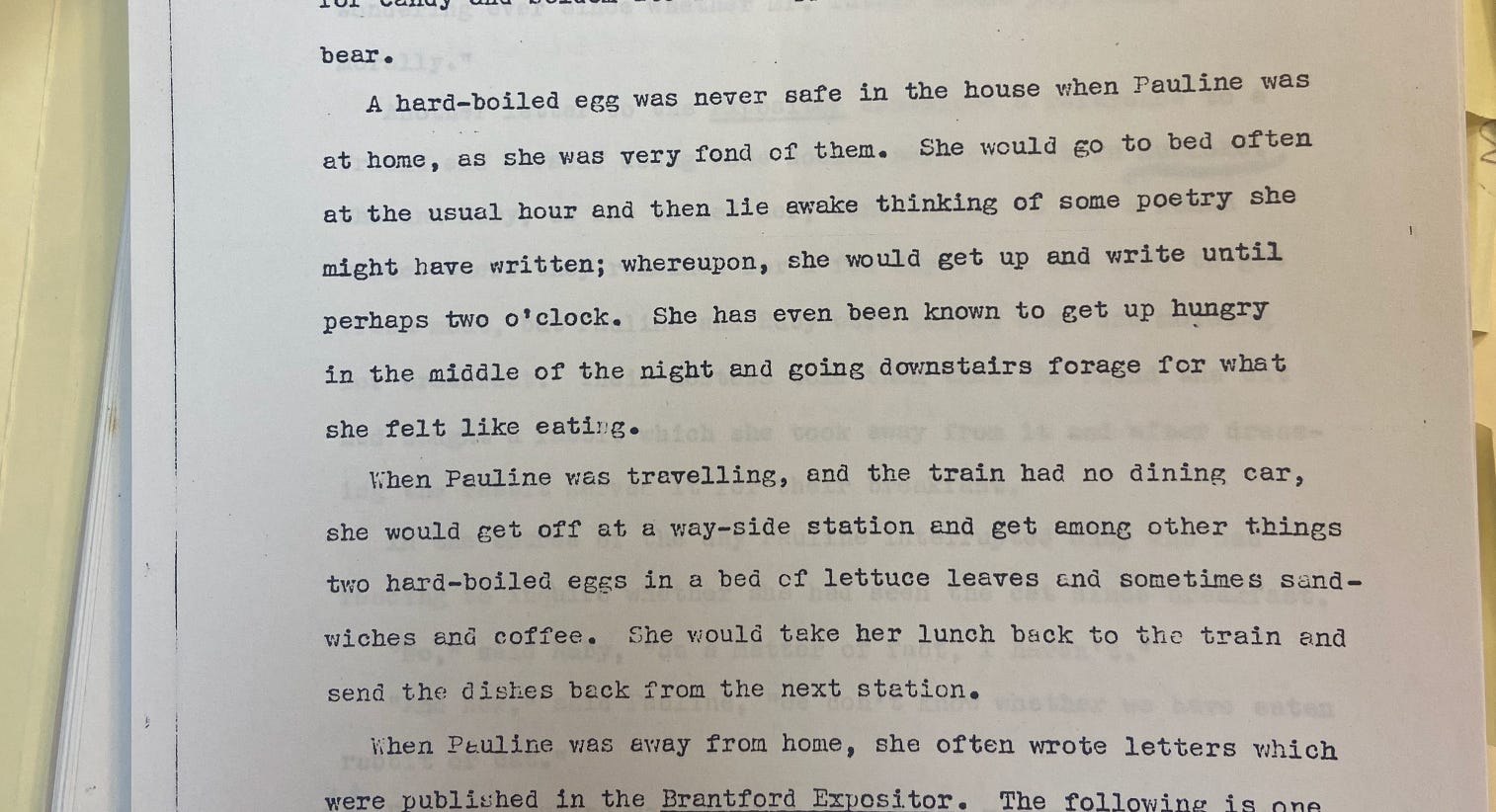
A couple weeks later when I went to organize my material, I realized that I had recreated, shot for shot, my research from the first time I’d consulted Charlotte Gray’s fonds. Not just the hardboiled egg story. I had photographed the same letter Pauline sent to her pal Archie Kains, the same pages from her friend Jean’s memoir of her friendship with Pauline. And when I looked at the dates, I realized I’d returned exactly four years to the week after my first visit. I’d first photographed that hardboiled egg story in March 2022, during my first parental leave, when my firstborn was six weeks old.
Oops. But was it a waste of time, replicating that research? It wasn’t. Obviously this is a long-term project. I’m only getting down to writing about Pauline now, years into squirreling away information, and I needed to reacquaint myself with my research anyway, and what better way to do it than with physical documents, handling papers and letters and Charlotte’s photocopies. I’ve visited the Pauline Johnson fonds several times too, also housed at McMaster’s archives. Sifting through Charlotte Gray's files again, the research wasn’t identical; there were a few small discoveries this time around. Even though I still couldn’t locate the exact childhood canoeing anecdote I was seeking, I found something adjacent, a valuable kernel of insight to Pauline’s fledgling paddling on the Grand River. And I’m once again immersed into Pauline’s canoeing writing, her decade of “pitching canvas,” and she wrote plenty of material about that.
Literary Creation grant
I am happy to share that I have received a Literary Creation Project grant from the Ontario Arts Council. This will fund my continued work on a collection of essays about loss. The essays explore my grief alongside the total solar eclipses in 1925 and 2024, spruce tree ID, canoe tripping, and nineteenth century parental grief, among other things.
I would like to acknowledge funding support from the Ontario Arts Council and the Government of Ontario. Thank you to both for supporting art, including my art. I’d also like to thank my MPP Robin Lennox for supporting art in Ontario too.

Oak leaves

One of the parking lots to access the trail system around Cootes Paradise Marsh is bordered by a circle of squat oak trees, their acorns pelting the hoods and roofs of cars from August through October. Once I watched Ray, when he was three-years-old, de…
Belted Kingfisher

The Belted Kingfisher (megaceryle alcyon) is a bird I can easily identify, because nothing else around here looks like it. It is the size of a robin with a giant head, almost like a distorted bluejay. Percy Algernon Taverner, from Guelph, wrote in 1922: “The great ragged crest and slaty blue back of the Kingfisher cannot be very well confused with any other American bird.”